Sunday, February 24, 2013

Dibs on Not Using DIBELS!


As we learn more about how ineffectual many of the “pop” reading assessments based on the “National Reading Panel’s (NRP) five pillars (phonemic awareness, phonics, fluency, vocabulary, and comprehension)” that seek to boil down “reading to a narrow set of skills that can be easily tested” (Wohlwend 2012, pg. 117) really are, what should we turn to instead?  We know that such assessments as DIBELS (Dynamic Indicators of Basic Early Literacy Skills) aren't cutting it, with their emphasis on constrained skills and lack of focus on comprehension.  So a turn to something more complex that measures comprehension and how it’s reached is necessary; something that incorporates not only an inquiry into how readers combine print and image information, but also how they navigate the interactive process of constructing meaning from what they read and how they navigate different cultural language patterns.  Simultaneously, there should be a restructuring of Reading First, based on more than the NRP’s five pillars, that would encourage teachers to teach not only fundamental skills, but also growth processes, such as reading comprehension and composition in writing (Baker & Pearson  2010).  Why are these changes so vital?  Because while being able to turn the text on the page into a mental or spoken stream of language is important, it doesn't do a student much good unless s/he is able to understand and manipulate what s/he’s reading.

Sources Cited:
Baker, E.A., & Pearson, PD.  (October 18, 2010).  “Reading first: Hard to live with—or without.”  Voice of literacy podcast.  Podcast retrieved from http://voiceofliteracy.org
Wohlwend, K. (2012).  “A new spin on miscue analysis:  Using spider charts to web reading processes.”  From Language Arts, 90(2), (pg. 110-117).

Monday, February 18, 2013

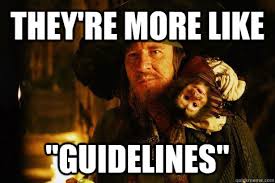
More than 100 Little Things...and "More Like 'Guidelines'"

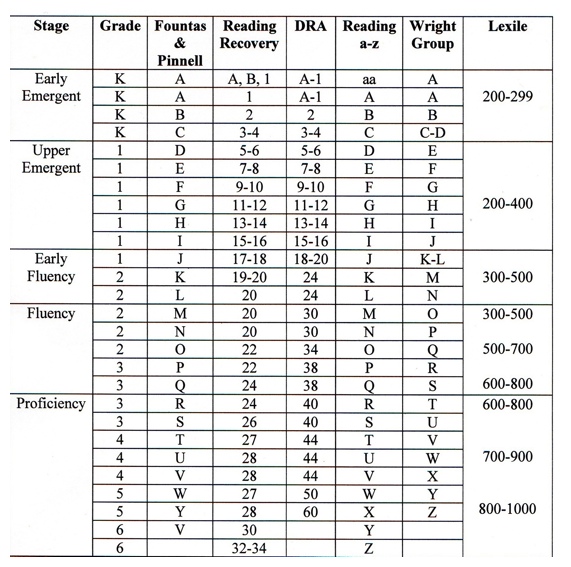
Despite the popularity of leveled reading instruction, there's a real possibility that it will become a one-size-fits-all instructional method that doesn't really fit anyone.  When students with very different instructional needs--but who have similar quantitative data on reading analyses--are grouped together and taught as though they all have the same needs, it can easily turn into a time in which none of them receive the instruction they actually need.  Furthermore, leveled readings often fail to take into account what will actually interest the students reading these texts, and particularly students who are reading below-grade-level.  When a third-grader is asked to read a highly repetitive book with little plot and no character development, it is little wonder that s/he becomes frustrated and bored; and when a child is denied access to a text simply because it is beyond his/her reading level (but would, in all actuality, be within reach with help), it seems counter-intuitive:  why would we ever discourage reading?  As Kath Glasswell and Michael Ford discuss in their article, "Let's Start Leveling about Leveling" (2011), the Wisconsin Department of Public Instruction has developed a model of reading that identifies 100 possible combinations of factors to which children may be exposed while reading:  5 major reader factors (motivation, subject knowledge, background experience, vocabulary, and purpose); 5 major text factors (content, format, concepts, organization, and author's purpose); and 4 major contextual factors (physical setting, activity, outcome, and emotional climate) (pp. 209-210).  With all of these factors to keep in mind, how can we possibly expect leveled reading to effectively guide us?  Especially in light of Glasswell and Ford's assertion that leveled reading:  1) oversimplifies text selection (by focusing on oral reading accuracy to match students to texts), 2) overly complicates text selection (which should be focused on providing students with materials that they're able to read), 3) results in teaching to levels, not to needs, 4) targets progress without aiming for proficiency (looking for results, rather than to catch a student up to his/her peers), and, 5) has the possibility to limit students' exposure to stimulating, challenging, and grade-appropriate learning (pp. 209-214).  Yet despite these objections, it can be quite detrimental for students to struggle through books that are too difficult for them, or to be bored to distraction by texts that are too easy, and--in theory, if not always in practice--leveled reading  is supposed to remove that possibility.  When treated as guidelines rather than as the final word on the matter, leveled reading can be a helpful tool to give parents and instructors both a general idea about what sorts of books may be suitable for an individual child...but it's important to remember that they are "more like 'guidelines!'"

Monday, February 11, 2013

Teaching Explicitly


When teachers use explicit language strategies--I mean, really share in adult language what is going on in their heads as they read and think--it helps students catch on.  Whether the teacher is talking about making connections with a text (text-to-self, text-to-text, or text-to-world) or helping them learn vocabulary, getting down to the nitty-gritty and authentically modeling and sharing makes it possible for students to do the same. In chapter 5 of her book Reading with Meaning:  Teaching Comprehension in the Primary Grades, Debbie Miller relates her struggles and successes with teaching kids how to access their schemas (the background knowledge they have available to them) as they read and think; she shares how every year it's a struggle and she's not sure they'll make it this time around...but they always do.  From simple connections like, "...my cousin's name is Eve" (p. 59) to more sophisticated ones such as being lost in a mall and the feelings associated with that (pp. 60-61), her students grow in their understanding of what it means to make solid connections to the themes and emotions within a text, and in their ability to discuss them.  But Miller’s careful preparation and explicit modeling go a very long way toward making these things possible.

On a somewhat related note, Dr. Susan Neuman talks about “Using Categories to Teach Vocabulary to Preschoolers,” and how creating themed vocab lists around a certain topic is useful not only for vocab-retention itself, but also for the discussions that can happen because of the categories.  For instance, she talks about how you can build the category of “fruit” from a discussion about apples, and you can incorporate into that a talk about how fruit is healthy and what it does for your body.  Neuman also points out that when doing this, you can use category games like BINGO or Jeopardy! to model strategies for organizing words, as well as to have some fun in your classroom.  Finally, a point where Neuman and Miller really agree is on their stress of adult-level conversation with kids:  without exposure to the words and patterns of speech that adults use, kids can’t pick up on them, which only holds them back.  So it’s vital to not only use sophisticated language with kids, but to explicitly express what it means and how concepts and strategies can be applied.

Saturday, February 2, 2013

Alphantastic Learning!


Dr. Shayne Piasta shares some of her research in a podcast called “Alphabet Learning and Early Literacy,” where her focus is on what she's discovered about how alphabet instruction can be used in conjunction with phonological awareness instruction and other forms of early literacy education in order to maximize the impact of students' time spent in these types of instructional settings.  Basically, she points out that when we make explicit the reading process we're going through, it helps the children with whom we're reading.  Specifically, she states that when parents point out individual sounds/letters as they’re reading and talk about their importance to the outcome of what’s on the page, it's particularly helpful for young children, especially when done in conjunction with discussions about the meaning of what's happening in the story.  Piasta's recommendation lines up nicely with what Catherine Compton-Lilly says in her article "'Sounding Out':  A Pervasive Cultural Model of Reading," where she highlights the popularity of "sound it out" as the fix-all answer for children when they come to a word they don't know, and points out that while even children cite this as the thing to do when they don't know a word, it's not actually that helpful, and it's not the thing that they're really practicing.  She says that strategies like going back and trying again, thinking in your brain, asking a friend for help, trying the first or last letter, looking at the context (pictures, other words), and making sure it makes sense are much more widely used and more helpful for students.

So what does this mean practically for those of us who are blessed to work with prephonemic learners?  It means being aware of our own reading process and being able and willing to translate our thoughts and strategies into explanations for the children around us.  Whether we're cooking together from a recipe, reading a bedtime story, or teaching a lesson, we can use the opportunities presented to point out that the pictures help us know what's going on, that the two slanted lines with a flat line in between is a capital "A" and usually says /ā/ or /ă/, or that sometimes we have to go back and re-read something to get the meaning or the pronunciation down.
All the wonderful alphabet books available are a great way to do this, like Stephen T. Johnson's Alphabet City or Suse MacDonald's Alphabatics, both of which are Caldecott Honor Books.  Getting sensory learners involved using shaving cream, finger paints, rice, sand or something similar in which to draw letters is a fun break from traditional worksheets, and jell-o letters are a tasty alternative.  And while not all poses are realistic for young kids--or, let's face it, me--to do, alphabet yoga is another fun way to get kids to connect with letters.
So on the never-ending journey to get kids to engage with learning and enjoy reading, help them to see the alphabet as a fun, friendly thing that will help them to "go off to Great Places," in the words of Dr. Seuss.